There is something wonderfully old-fashioned about learning to forage. Before grocery stores, apps, and brightly labeled packages, people had to pay attention to what was growing around them. They knew the land and learned the trees. They noticed when berries appeared. They understood which plants preferred wet ground and which appeared after disturbance. They watched animals and learned from the seasons.
Foraging is really the art of paying attention.
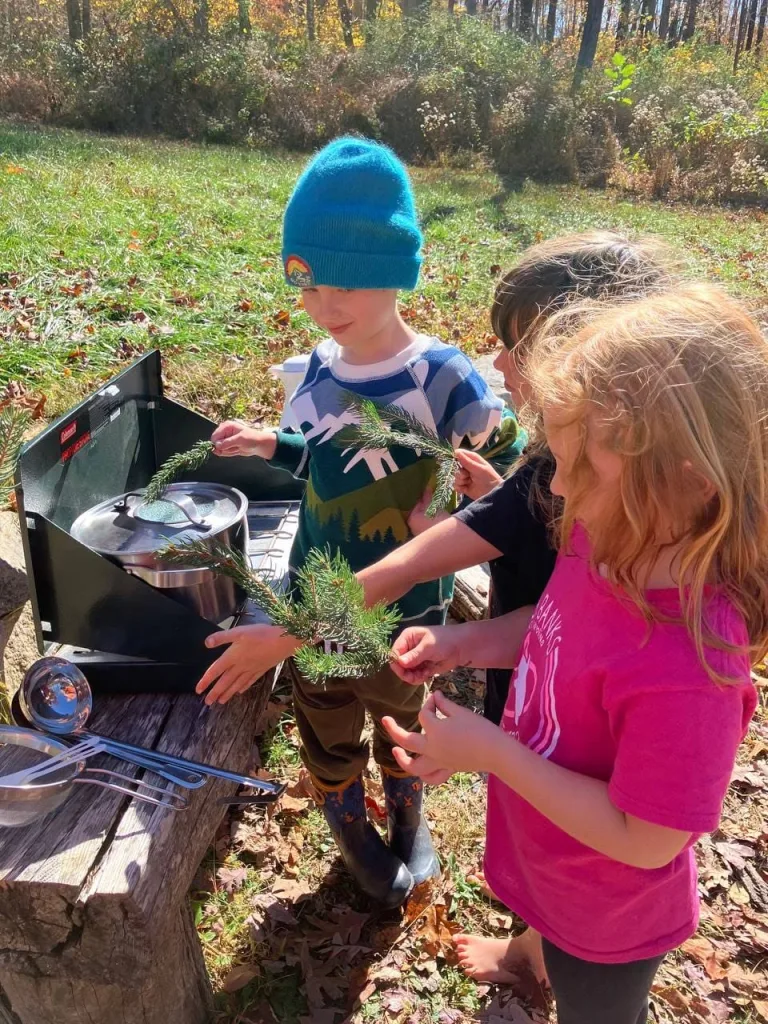
And that makes it a beautiful fit for forest school and homeschool learning. But when children are involved, foraging needs to look a little different than the typical “grab a bag and go find dinner” approach. The goal is to teach them to become careful observers of the living world.
We forage every year at BU, but Rhythm Earth really gives way to knowing more about the ground that plants around us grow from and the animals that depend on them. And of course, the seasons that bring everything into being.
Foraging gives us a way to do exactly that.
First Rule: Know Before You Pick
The most important foraging rule is simple:
If you don’t know what it is, don’t eat it.
Not “I think it’s probably…”
Not “It looks like the picture…”
Not “Someone on the internet said…”
Know exactly. And ask a grown-up if it’s ok.
Some plants have toxic look-alikes, and some can cause serious illness or skin reactions. Kids (or adults!) should never be encouraged to taste-test an unidentified plant.
Wild mushrooms deserve an even stronger warning. Poison Control advises that wild mushrooms should not be eaten unless they have been identified by an appropriately trained expert. Some poisonous mushrooms closely resemble edible ones, and cooking does not reliably make poisonous mushrooms safe.
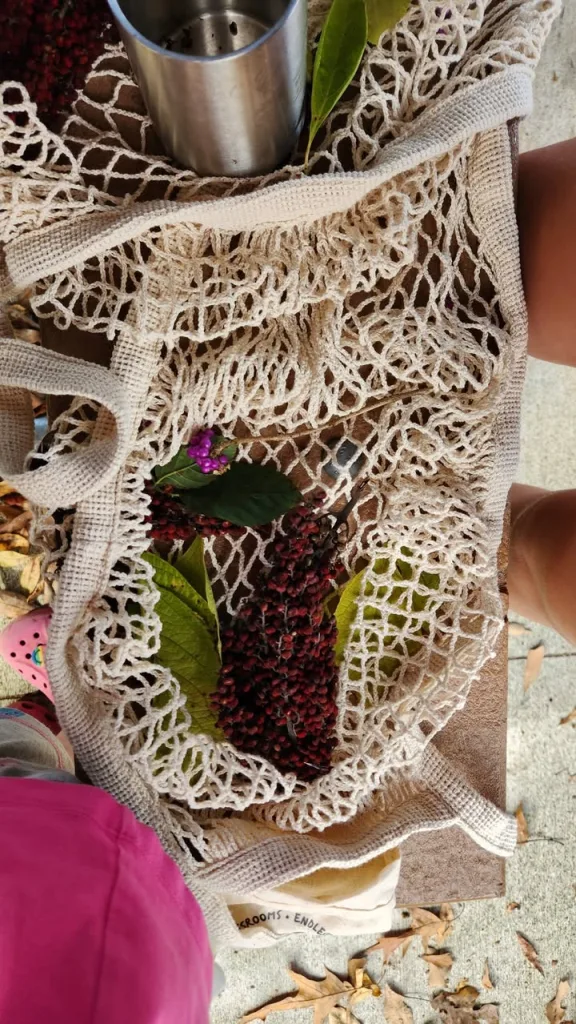
For a forest-school group, this means that observation is always a successful activity. You can photograph a plant. Sketch it. Measure it. Identify it. Study its habitat. Look at its leaves. Watch the insects visiting it. Research what animals eat it. You don’t have to put it in a foraging bag or eat it.
Foraging Is About More Than Food
One of the best things about introducing kids to foraging is that it naturally crosses subjects. A single plant can become an entire homeschool lesson.
Science: What kind of plant is it? How does it reproduce? What pollinates it? What soil does it prefer?
Ecology: What animals depend on it? What happens when the plant disappears?
Geography: Where does this species grow? Why doesn’t it grow everywhere?
History: How have people used this plant historically?
Writing: Describe the plant in a field journal.
Art: Create a botanical sketch.
Math: Count plants in a sample area. Measure growth. Compare leaves.
Weather: How does rainfall, drought, frost, or heat change when plants appear?
Health and safety: What makes a plant safe or unsafe to touch or consume?
Suddenly, a walk in the woods isn’t just a walk. It’s school.
The Rules Are Part of the Lesson
One of the most important things children can learn about foraging is that we don’t automatically have permission to take things simply because they are growing outside.
Land ownership and land-management rules matter. Private property requires permission. Public lands have different rules depending on who manages them and where you are. National parks are particularly important to understand: the National Park Service generally prohibits removing plants and other natural resources unless a specific exception applies. Some parks may designate certain fruits, berries, or nuts for hand gathering, but those rules are site-specific.
Other public lands may allow limited collection under specific conditions. For example, some Bureau of Land Management regulations allow reasonable amounts of certain common renewable resources for noncommercial use, unless the area or resource is otherwise restricted.
In other words, “It’s public land” does not automatically mean “take whatever you want.” This is actually a fantastic forest-school lesson.
Before your family collects anything, ask:
- Who manages this land?
- Are we allowed to collect here?
- Is this species protected?
- Is there a seasonal restriction?
- Is there a quantity limit?
- Do we need permission or a permit?
- Are we collecting for personal use or for a commercial purpose?
Learning the rules is part of learning to be a responsible land steward.
Take Little. Leave Much.
Even when harvesting is allowed, ethical foraging means thinking about what we leave behind.
The forest is not a grocery store waiting for us. Those berries may be food for birds. Those seeds may be tomorrow’s plants. Those flowers may be feeding pollinators. That mushroom may be part of a much larger underground relationship. That plant may be growing in a small population that cannot afford to lose many individuals. Good foragers pay attention to abundance and impact.
A useful rule is: Take little. Leave much.
Don’t trample the plants. Don’t dig up plants unnecessarily. Don’t disturb nests or wildlife. Don’t harvest from contaminated or sprayed places. Don’t strip an entire patch because you found something you like. And sometimes, the most ethical choice is to take nothing at all.
The U.S. Forest Service has similarly emphasized positive identification, restraint, avoiding damage to soil and vegetation, avoiding roadside harvesting, and cooperating with landowners and land managers.
North America Is a Big Place
A foraging lesson that makes perfect sense in Tennessee may not make sense in Arizona, Colorado, Florida, Connecticut, or Oklahoma.
Plants don’t follow our curriculum calendars. A plant may be flowering in one region while another region is buried under snow. A species common in one state may be rare or absent a few hundred miles away. Regulations can change from one piece of public land to another.
Plants don’t follow our curriculum calendars. A plant may be flowering in one region while another region is buried under snow. A species common in one state may be rare or absent a few hundred miles away. Regulations can change from one piece of public land to another.
We want children to learn how to learn their own landscape. To do this successfully, parents have to take an active roll in finding local resources and learning alongside their Barefooter. The Tracey family in Tennessee created a downloadable 36-week foraging book for you to help get you started. You can download it at the end of this post!
A Better Way to Teach Children to Forage
We like to think about foraging as seven steps:
1. Notice.
Slow down and look.
2. Locate.
Where is the plant growing?
3. Identify.
Learn its characteristics and confirm its identity.
4. Compare.
What could it be confused with?
5. Check the rules.
Are we actually allowed to collect it here?
6. Decide.
Should we observe, photograph, sketch—or, when appropriate, harvest?
7. Give back.
How can we leave this place healthier than we found it?
That last step may be the most important. We aren’t teaching kids to take from nature. We’re teaching them to belong to a place responsibly. Some weeks are about harvesting. Many are deliberately about not harvesting. Because sometimes the best thing a young forager can learn is how to kneel beside a plant, study it closely, draw it in a journal, and leave it exactly where it is.
That’s how observation becomes knowledge. And knowledge becomes stewardship.
Download the Free Rhythm Earth Foraging Field Book
Free 36-week printable field book: A gift for your family to use this year!
Download the Free Rhythm Earth 36-Week Foraging Field Book
Use it as a complete 36-week study, pull out individual activities for your forest-school days, or let your children choose a plant and follow it through the seasons.
And remember:
A successful foraging day isn’t measured by how full your foraging bag is. Sometimes it is measured by how much more you notice than you did when you arrived.
Disclaimer
Foraging involves inherent risks. This resource is intended for educational and nature-study purposes only and is not a guide for determining whether a plant, mushroom, berry, seed, or other natural material is safe to eat, touch, harvest, or use.
Plant species, poisonous look-alikes, growing conditions, contamination risks, and foraging laws vary widely throughout North America. Always positively identify any species before considering contact or consumption, use multiple reliable identification resources, and consult a qualified local expert when there is any uncertainty. Never consume a wild plant or mushroom based solely on information in this resource.
Families are responsible for supervising children, assessing risks, obtaining appropriate landowner or land-manager permission, and following all applicable federal, state, provincial, local, and property-specific rules regarding collection.
When in doubt, leave it out. Observation, photography, sketching, and studying a plant are always valid forms of foraging education.
Barefoot University and its leaders, volunteers, contributors, and affiliates assume no responsibility for injury, illness, allergic reaction, poisoning, property damage, or legal consequences resulting from the use of this resource or participation in foraging activities. This resource does not replace professional medical, botanical, legal, or land-management advice.
Teach children to observe first, identify carefully, respect the land, and harvest only when it is safe, legal, and appropriate.