
We are so excited about Rhythm Earth!
This year, we are turning our attention downward — to the ground beneath our feet, the rocks in our pockets, the roots beneath the trees, the tiny creatures hiding in the soil, and all the incredible life that depends on the earth.
One of the things we love most about learning in nature is that the learning doesn’t have to stop when you leave your Barefoot University meetup. In fact, some of the best learning happens when a child gets home and thinks, Wait… I want to know more about that.
So we’ve put together a collection of resources to help you deepen your Rhythm Earth learning at home.
You absolutely do not need any of these things to participate in Rhythm Earth. A backyard, a patch of dirt, a handful of rocks, and a curious child are already enough. But if your Barefooter wants to dig deeper, experiment, investigate, collect, create, or read more, these are some fun options.
A note for parents: We’ve included ideas for a range of ages, from younger Barefooters who are just beginning to notice the natural world to older students who are ready to investigate Earth science, ecology, botany, and geology more deeply.
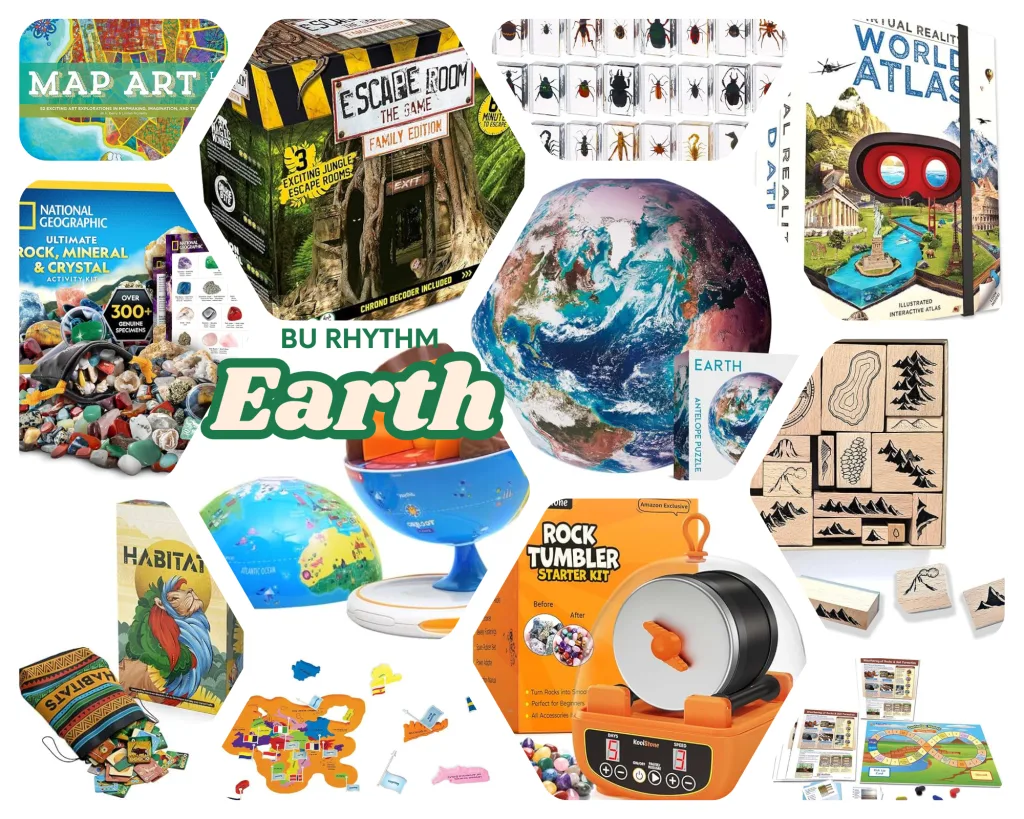
START WITH THE BIG PICTURE
The Ultimate Book of Planet Earth
Explore The Ultimate Book of Planet Earth
For the child who is constantly asking, “But WHY?”
Use this as a jumping-off point for questions about volcanoes, mountains, oceans, rocks, weather, landforms, and the amazing systems that make Earth our home.
Try this: Let your child choose one page or topic that interests them. Then go outside and find something connected to it.
Biomes: Discover the Earth’s Ecosystems
Explore Biomes: Discover the Earth’s Ecosystems
Earth isn’t just dirt and rocks. It is a collection of interconnected ecosystems, each with its own plants, animals, climate, and relationships.
Try this: Choose a biome and build a miniature version using natural materials, drawings, clay, or loose parts.
An Anthology of Extraordinary Earth
Explore An Anthology of Extraordinary Earth
Perfect for the Barefooter who loves fascinating facts, beautiful illustrations, and getting lost in a topic.
Try this: Pick one fact that surprises you and see if you can find evidence of something similar in your own environment.
ROCKS, MINERALS & GEOLOGY
Rhythm Earth is the perfect excuse to start a rock collection.
And we’re not talking about buying a bunch of rocks and putting them on a shelf. We’re talking about picking up rocks, examining them, sorting them, comparing them, asking questions about where they came from, and wondering how long they’ve been here.
Rock Collection Starter Kit
Explore the Rock Collection Starter Kit
Use a collection like this to begin learning the differences between rocks and minerals.
Try this: Start a family rock collection. Give each rock a number and create a field journal with its color, texture, hardness, location, and any other observations.
EISCO Mineral Kit
A great option for older Barefooters who are ready to move from “cool rock!” to actually investigating mineral properties.
Try this: Compare several minerals and make a chart of their observable characteristics.
Weathering Rocks: Rock Formation Learning Center
Explore Weathering Rocks: Rock Formation Learning Center
This is a fun way to explore one of the big ideas behind Rhythm Earth: the earth is constantly changing.
Rocks break down. Sediment moves. New rocks form. Landscapes change.
Try this: Find a rock outside that shows signs of weathering. What do you notice? Cracks? Rough edges? Different colors? Moss or lichen? Make a sketch of it and check it again later.
Kids Rock Painting Kit
Explore the Kids Rock Painting Kit
Sometimes the best way to slow down and really look at something is to turn it into art.
Try this: Paint rocks inspired by things you find outside — leaves, mushrooms, insects, animals, flowers, or patterns from nature.
Rock Tumbler
A rock tumbler gives kids a chance to see transformation happen over time.
Sharp, ordinary rocks go through repeated cycles of tumbling, grit, and polishing until their colors and patterns become much easier to see.
Try this: Have your Barefooter predict which rocks will change the most before beginning the process. Keep a journal of observations throughout.
TREES, PLANTS & THE LIVING EARTH
One of the most important ideas in Rhythm Earth is that the ground is alive.
Roots reach into it. Fungi connect through it. Worms move through it. Plants depend on it. Animals depend on plants. And all of those relationships are happening beneath our feet.
Can You Name 50 Trees Today?
Explore Can You Name 50 Trees Today?
This is a great challenge for older Barefooters who are ready to become serious tree detectives.
Try this: Start with five trees in your yard or neighborhood. Learn to identify them by their leaves, bark, shape, fruit, and location.
Treecology
Turn your next tree walk into an investigation.
Instead of simply saying, “That’s an oak,” ask: What is living on it? What is growing around it? What does the bark feel like? What animals use it? What changes throughout the year?
Match the Leaf & Tree Memory Game
Explore the Leaf & Tree Memory Game
A simple way for younger learners to begin connecting leaves with trees.
Try this: Take the game outside. Find real leaves that match the cards and compare the real thing to the illustration.
Plant Science & Horticulture for Teens
Explore Plant Science & Horticulture for Teens
For older Barefooters who are ready to go beyond identifying plants and start thinking about how plants actually grow.
Try this: Start an experiment. Change one variable — light, water, soil, temperature, or fertilizer — and document what happens.
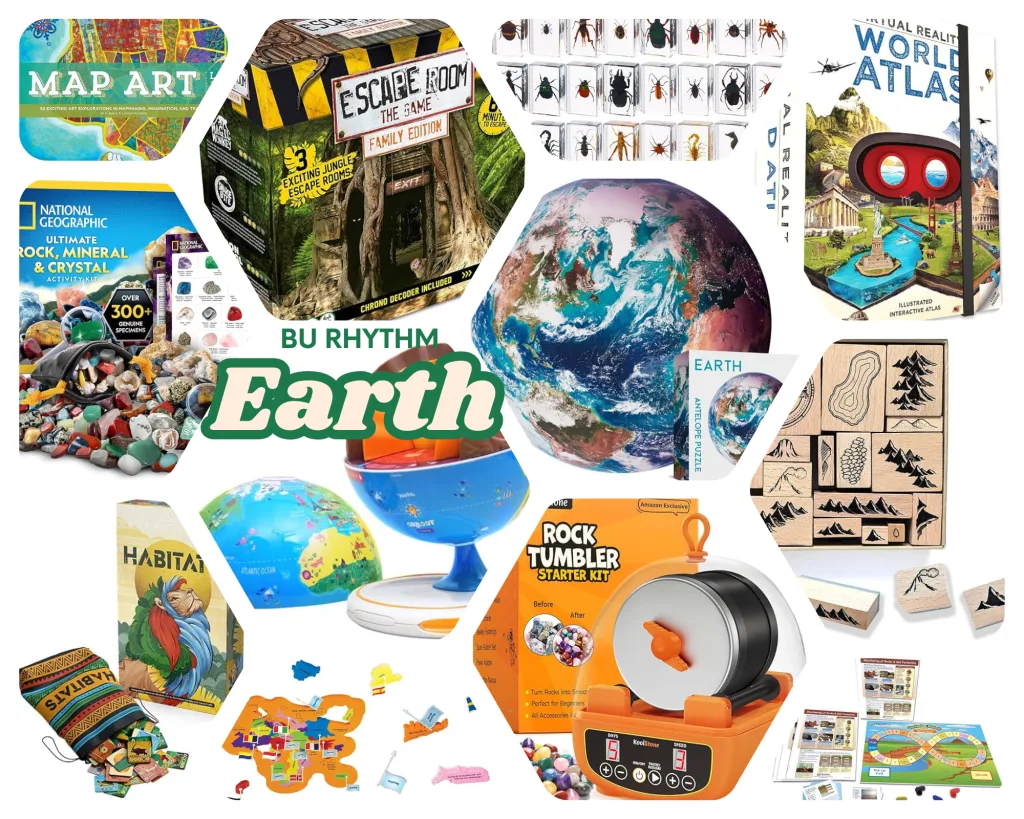
SOIL: THE WORLD BENEATH OUR FEET
Soil is easy to overlook because we walk on it every day.
But scoop up a handful and suddenly there is an entire world to investigate.
There are minerals, organic matter, water, air, roots, fungi, insects, worms, and microorganisms all interacting in a tiny ecosystem.
Your World Through a Microscope
Explore Your World Through a Microscope
Perfect for taking the Rhythm Earth experience from the backyard to the microscopic world.
Try this: Look at soil, sand, leaves, bark, moss, or water from a puddle. Ask: What did you expect to see? What did you actually see?
Botany: A Strategy Game
Explore Botany: A Strategy Game
A game can be a surprisingly good way to reinforce concepts without making learning feel like another assignment.
Use it as a starting point for conversations about plants, competition, growth, and ecosystems.
Klever Kits Planting Science / Viewer
Explore the Planting Science Viewer Kit
For the Barefooter who wants to get closer to the tiny details of plants and the living world.
Try this: Choose one plant and investigate it from the ground up — roots, stem, leaves, flowers, seeds, and everything in between.
ANIMALS & THE PLACES THEY LIVE
The earth isn’t just where animals walk.
It is where they hide, hunt, burrow, nest, find food, raise their young, and build homes.
Habitats Board Game
This is a great way to connect animals with the places they depend on.
Try this: After playing, choose an animal from your area and ask your child to design its ideal habitat. What does it need for food? Water? Shelter? Space? What happens if one part of its habitat changes?
Tracks, Scats & Signs
You don’t have to see an animal to know it was there.
Learning to notice tracks, scat, feeding signs, nests, scratches, fur, feathers, and other clues turns an ordinary walk into detective work.
Try this: Go on a “Who Was Here?” walk. Don’t look for animals. Look for evidence of animals.
Animal Tracks: Midwest
Explore Animal Tracks: Midwest
A useful companion for families who want to get better at identifying the tracks they actually encounter outside.
Match the Track
A simple option for younger learners who are beginning to recognize animal footprints.
Who Pooped? Matching Memory Game
Explore Who Pooped? Matching Memory Game
Because sometimes the fastest way to get a kid interested in animal science is to let them talk about poop.
Use it as an introduction to animal diets, digestion, and the clues animals leave behind.
BUGS & THE TINY CREATURES OF EARTH
If your Barefooter has ever turned over a log and immediately yelled, “LOOK WHAT I FOUND!” — this section is for them.
The tiny creatures living in and around the soil are some of the most important characters in the Rhythm Earth story.
The Ultimate Bugopedia
Explore The Ultimate Bugopedia
A great reference for curious kids who want to know what they’re finding.
Try this: Go outside with a notebook and investigate one small area for ten minutes. How many different kinds of tiny creatures can you find?
Scientific Insect Collection
Explore the Scientific Insect Collection
Use it to compare body structures, identify insect groups, and practice observation.
BUILD A MINIATURE WORLD
Sometimes a child understands an ecosystem best when they get to build one.
National Geographic Terrarium Kit
Explore the National Geographic Terrarium Kit
15-Piece Terrarium Kit
Explore the 15-Piece Terrarium Kit
Terrariums are a wonderful way to observe a miniature ecosystem over time.
Try this: Build one and then resist the urge to “fix” it. Watch what happens. What grows? What changes? Where does condensation appear? Which parts stay damp? What happens when the light changes?
FORAGING & PLANT CONNECTIONS
Enchanted Foraging Deck
Explore the Enchanted Foraging Deck
Foraging can turn a walk into a lesson in plant identification, seasonal change, food systems, and observation.
Important: Always teach children that plant identification must come before tasting anything in the wild. Use a trusted local expert or field guide for edible plant identification.
Try this: Instead of collecting anything, go on a “find and identify” walk. How many edible plants can you identify without picking them?
FOR THE CREATIVE BAREFOOTER
Not every child wants to sit down and read about geology.
Some want to make something.
And that’s okay.
Rock Painting Kit
Explore the Kids Rock Painting Kit
Paint rocks inspired by the natural world.
Try painting mushrooms, leaves, insects, animal tracks, flowers, or even the layers of Earth.
Planted Puzzle
A quieter way to explore plants while building pattern recognition and visual observation.
FOR THE OLDER BAREFOOTER
Rhythm Earth doesn’t stop being interesting when you get older.
In fact, the older you get, the more complicated the questions become.
Why is this soil different from that soil?
Why does this tree grow here?
How does a plant move water?
How do organisms affect one another?
How does geology shape ecosystems?
What happens when humans change an environment?
For older students, try pairing hands-on experiences with resources like:
Plant Science & Horticulture for Teens
Explore Plant Science & Horticulture for Teens
Your World Through a Microscope
Explore Your World Through a Microscope
Treecology
An Escape Room Game
Build Your Own LEGO Escape Room
Explore Build Your Own LEGO Escape Room
Challenge them to take what they’re learning and create something of their own: an experiment, field guide, ecosystem model, research project, nature journal, board game, documentary, or presentation.
You Don’t Need to Buy Anything
We really mean this.
The best Rhythm Earth resource is still outside.
Go turn over a log.
Pick up a rock.
Dig a hole.
Look at the roots of a plant.
Follow an animal track.
Watch an ant.
Collect leaves.
Compare two patches of soil.
Sit under a tree.
Look closely.
Ask questions.
And then ask one more.
The goal isn’t to collect educational products. The goal is to help our Barefooters develop the habit of wondering about the world around them. Rhythm Earth is an invitation to get curious about the ground beneath our feet and everything that depends on it.
So grab a magnifying glass, a notebook, a bucket, or absolutely nothing at all.
Go outside and see what you can find.
Some of the links in this post are affiliate links. If you purchase through one of our links, Barefoot University may receive a small commission at no additional cost to you. Thank you for supporting BU and helping us continue connecting homeschooling families to nature and each other.